

It was 2024 when I first saw it: an image of Jacob Elordi in a leather jacket and cargo pants. A novel poked out of his pants pocket. But wait, he held a book in both his left and right hand. All three appeared to be fiction.
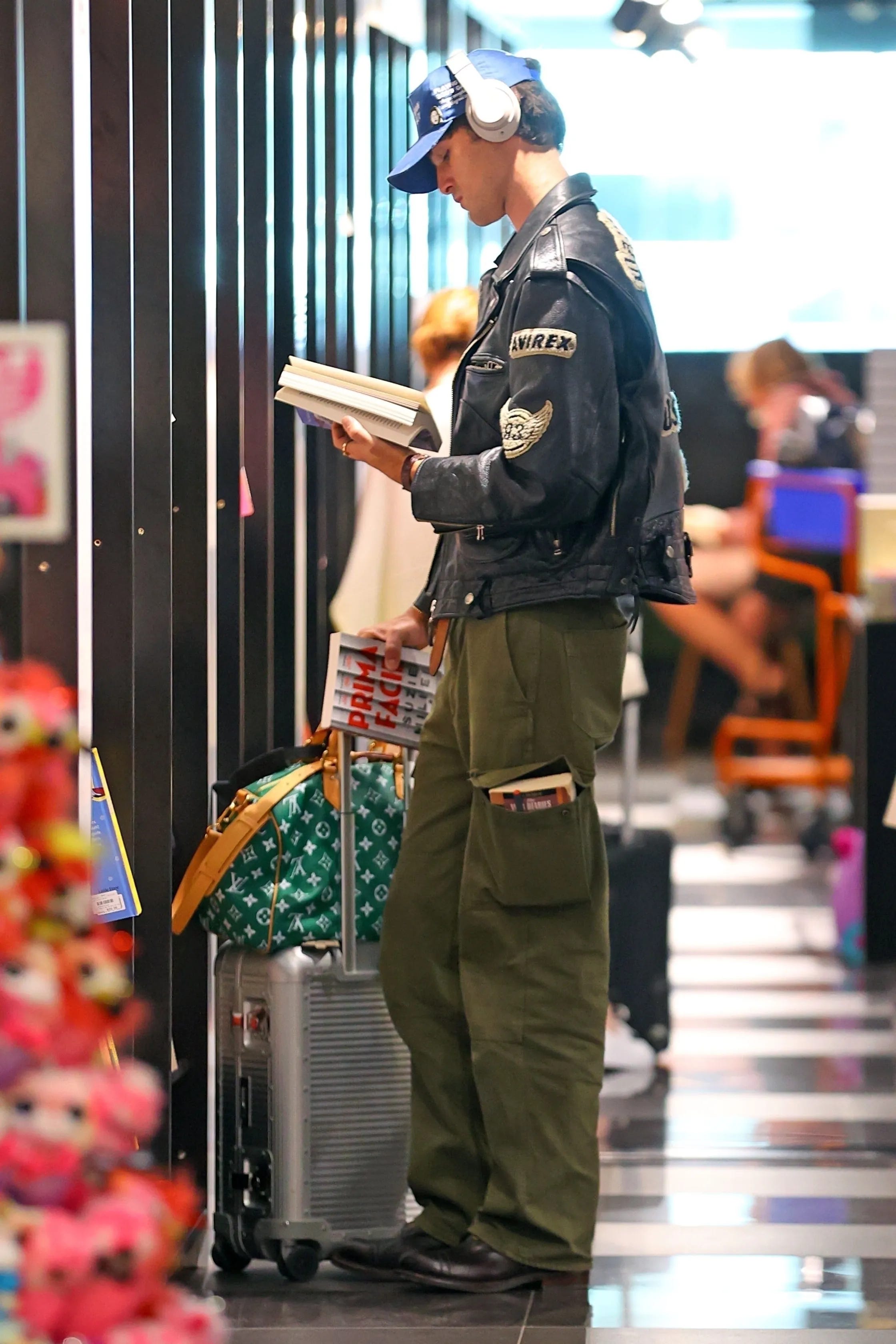
Consider me breathless.
My fingers pulsed from both panic and joy. I said aloud, please do not slam him for this.
To the comment sections. As far as I’m concerned, Jacob has always been six foot five with a lovely jawline, attributes the internet commonly praises him for. Yet this discovery, the sight of a man interested in novels, transformed the women of the internet from complimentary to downright licentious. The sheer traction and affection this image garnered piqued my interest.
I have no evidence to the contrary, but I retrospectively assert that if Jacob had been spotted reading The Subtle Art of Not Giving a F*ck or The Courage to be Disliked, he would have been raked over the internet’s metaphorical coals.
Women, en masse it seemed, were desperate for a man who reads … fiction.
I attended an all-girls high school, and it was not uncommon to return from summer holidays and share which books we’d devoured. At university, I studied creative writing, and naturally, was subjected to a small handful of men who read fiction. I was naïve to think that reading novels for leisure, pleasure, or curiosity was a common pastime. It was only when I went to a university party that I grasped this was not the case at all. The men at said party, upon learning I was a writing major, asked not what I liked to read or write, but instead recommended Dune, as though it were niche or canon. More scarily still, almost all recommended Lolita in the hopes, I fear, to impress me. The two books were mentioned enough times that I asked my female friends if they had dared the men to prank me. They had not.
After university, it was rare for a man to use a novel’s title as a means of flirting with me. Often with new jobs secured at fancy firms, they no longer needed to rely on pretending to share my interests, even if their pretence previously involved predictable recommendations. For now, to them, they had more to offer: a salary and a cruel boss who they admired deeply, in a sick Stockholm syndrome style.
So, I overcorrected.
In late night shifts at a restaurant, I connected with a man who had thin-lined tattoos, recited poetry, and had a proclivity for cocaine. He once recited lines of Michael Ondaatje’s The Cinnamon Peeler to me over a half-eaten meal of microwaved risotto, and I looked at him the way women in novels look at men who read poetry. It lasted about three weeks. The poetry did not survive his personality, which turned out to be mostly poetry.
Of course, there were and are men in my life who read, regularly and widely, ahem, nOtaLLmeN. But they’re few and far between.
By my mid-twenties, I was dating a man who looked really good on a surfboard and who, while on a footpath with me, insisted I walk on the side farthest from the road so he could protect me from traffic. Swoon. This was more like it: long days in the sun, the smell of salt and tobacco on his skin. While he surfed, I read. Our hobbies seemed to overlap enough to create a complimentary lifestyle. Yet still, I ached to lie beside someone who could enjoy silence with a book in his hand. Yes, our active hobbies aligned, but when it came to downtime, he found far more comfort with a phone in his hand. And when he did read in front of me, it was nonfiction, either a self-help bestseller or the kind with a one-word title and a subtitle about systems.
This was the pattern I started to see.
Men read things that told them what to do, and women read things that asked them who they were.
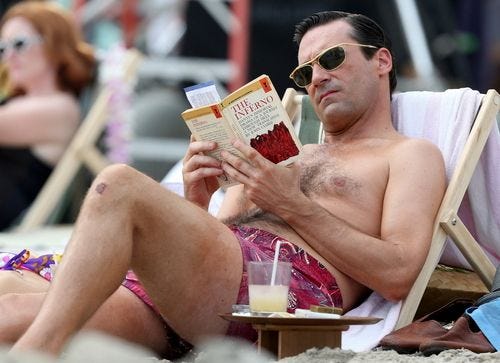
Fairly or unfairly, I blame the marketing of fiction as feminine, the unfortunate connotation being it is therefore, frivolous. I’ve seen this occur regularly where television shows with a predominantly female audience, or pop stars with a female fan base, are deemed lightweight interests. I was embarrassed I hadn’t considered before the now obvious cultural conditioning men had received. Nonfiction, and its clever marketing to men, equals ‘serious’ reading. Yet along the way in the mass marketing machine, someone forgot to mention the tangible benefits of reading fiction that go beyond entertainment, how it increases empathy, reduces stress, and enhances cognitive function. I want to slip Elizabeth Strout’s My Name is Lucy Barton into every finance bro’s briefcase so he can understand the complex, often strained relationship between mothers and daughters.
Rather sadly, I’ve begged boyfriends to read. My most recent ex openly hated reading. I found his honesty both refreshing and cruel. It provoked much contemplation. How could he date a writer and despise the product of my craft? And why, after learning that reading was something I found attractive in a partner, did he refuse to even try?
Here is what I eventually understood. I was asking him to prove he could spend time with a consciousness that wasn’t his own, that he could sit still, and that he could be curious without being instructed. I had created an inextricable link which suggested if he could specifically tolerate a woman’s interiority on a page, he could tolerate one in bed, and in life.
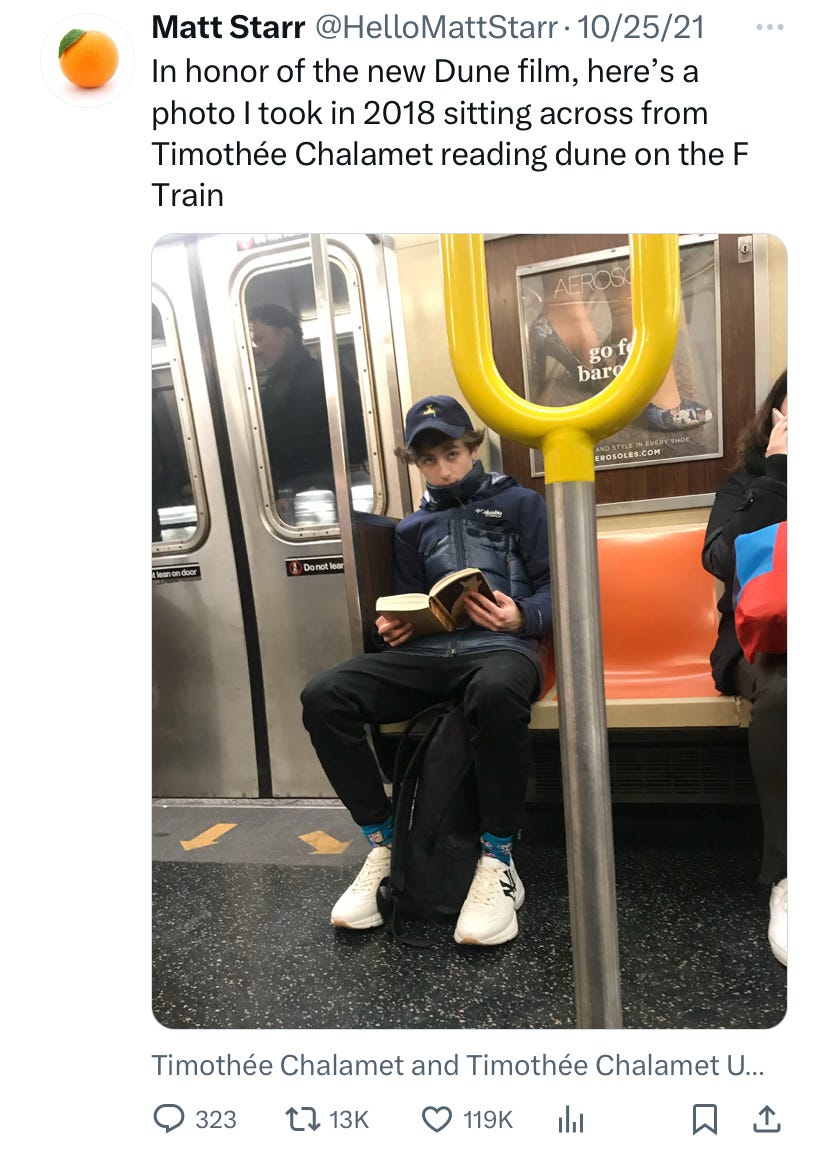
Amid Jacob-Elordi-book-in-pocket-gate, my algorithm fed me a corner of the internet that revealed a trend known as performative reading, where, and this is only one definition, one carries a physical book in public to curate themself as sophisticated. Men saw no issue with using literature as a non-verbal pick-up line.
Female-run accounts uploaded short clips of men in cafes, bars, trains, and parks who managed to sit in one spot for a long time without so much as turning a page. Though not driven to actually read a novel, men were confident enough to attempt to con women. Their chosen texts were calculated to attract: Sally Rooney’s Normal People, Ottessa Moshfegh’s My Year of Rest and Relaxation.
Can’t you see him now. He wears a light sweater and a wide leg pant.
He drinks a matcha, or an iced latte on anything but cow’s milk. He’s aware women are watching him ‘read’ The Bell Jar.
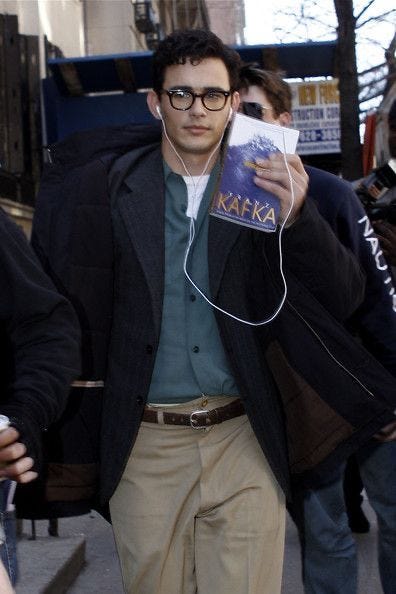
There was one poor, silly man who performed too well. He was so ‘consumed’ by the characters, and not at all focused on impressing women in real life, that his novel was in fact upside down. Would it not have been easier to simply read the book?
I should have felt enraged by the trend, but I felt humoured and woefully hopeful. At least they had a book in their hand. At least the performance of being a man who reads fiction now counted as a form of flirting. At least something in the culture had decided this was a trait worth faking.
Now, on first dates, I skip mediocre questions about how many siblings he has, or how long he’s had his dog for. Over a bowl of shoestring fries and overpriced aioli, I wait for him to ask me about my favourite book. And when he doesn’t, I ask him his favourite.
The pause, though expected, never ceases to be frightening.
I used to think the pause meant he wasn’t my person.
Now I think the pause means that an entire generation of men was raised to believe interior life is a woman’s sport, and imagination is soft.
That fateful pause means that the measure of a written work is what can be extracted from it, and that a novel, which asks one to surrender rather than extract, is therefore a waste.
I do not want a man to read fiction so we can compare notes on The Correspondent.
I want him to read fiction because I want proof he is capable of seeking out something other than concrete information, that he is open to a story he did not already agree with, that he is willing, for three hundred pages, to be a woman, or a child, or a horse, or a ghost.
Constance Allan is an Australian writer who writes fiction, the occasional personal essay, and is otherwise in the ocean. More of her work here.